
01
Eligibility Review
we examine family relationships, birth dates, places of birth and citizenship history
to determine which current Spanish citizenship route should be considered.
CITIZENSHIP SPECIALISTS
If you live in Miami and need help with a Spanish citizenship case, Díaz & Asociados can manage the process from Spain, from locating family records to preparing your application and guiding you through the final registration or swearing-in requirements when they apply.
Request a free initial assessment. Tell us about your connection to Spain and the documents you already have, and we will identify the first step before you spend money obtaining additional records.
100% Online Service
from Miami
Personalized Legal
Advice
Over 10 Years Helping
Spaniards Worldwide
MIAMI, FLORIDA, USA

Your story matters too
SPANISH CITIZENSHIP IN MIAMI
Spanish Citizenship Lawyer Miami: We Handle the Full Process
You work directly with Spanish lawyers by video call, without needing a local office in Miami.
A legal team by your side, no matter the distance.
OUR SERVICES
Our first job is to establish the legal route. Only then do we build the documentary file around it.
We examine family relationships, birth dates, places of birth and citizenship history to determine which current Spanish citizenship route should be considered.
When a Spanish birth certificate is missing, we can direct searches to the appropriate Registro Civil (Spain’s Civil Registry), municipal archives, parishes or diocesan archives.
We review certificates, family links and inconsistencies and identify when apostilles, legalization or sworn translations are required.
We explain which Spanish authority or consular office is competent, which steps may permit representation and when you must appear personally.
We review official communications and requests to correct or complete the application.
Where applicable, we help prepare for the swearing-in ceremony (acto de jura) and subsequent Civil Registry steps.
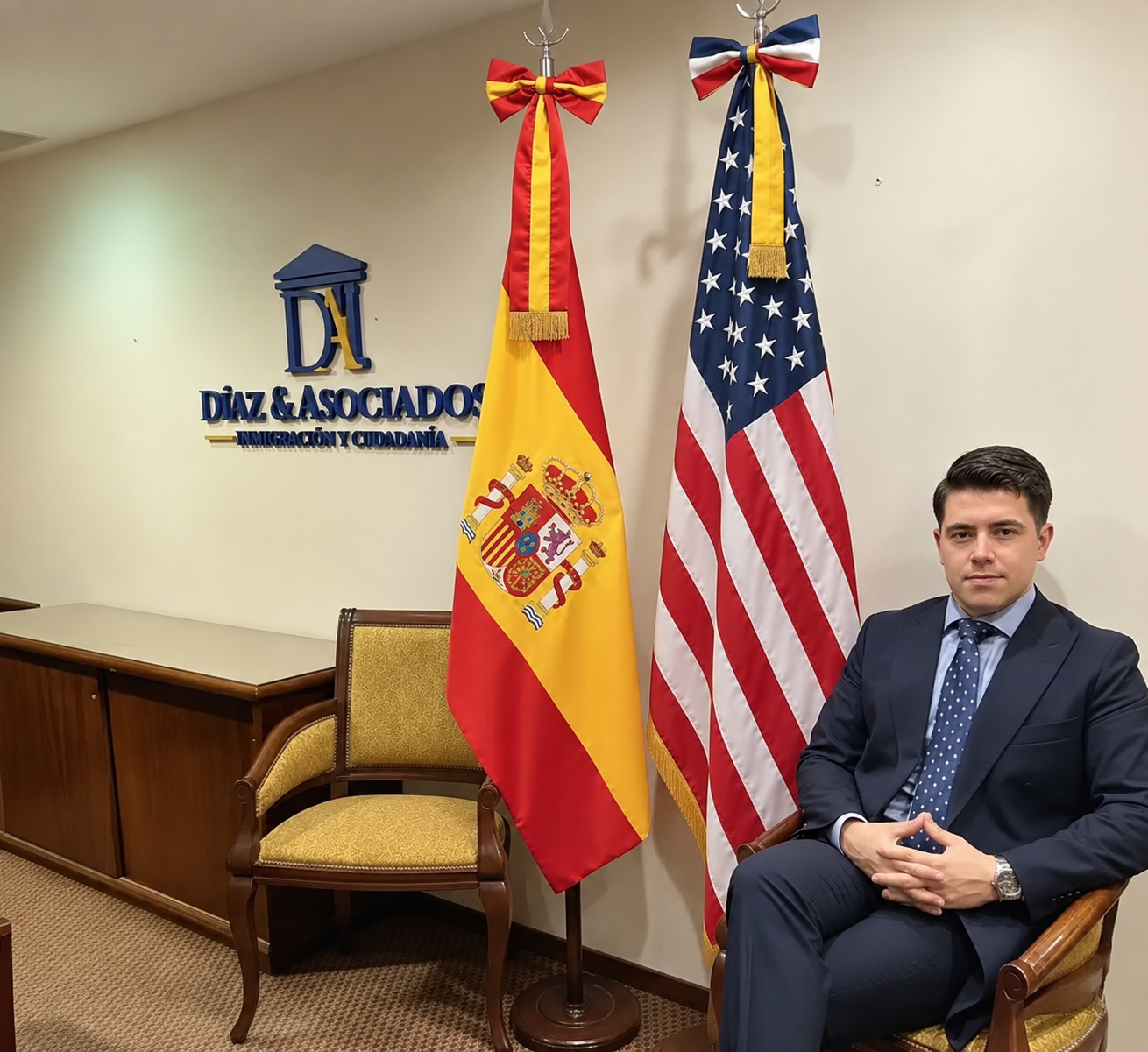
YOUR CITIZENSHIP, WITHOUT BORDERS
We work from Spain and meet U.S. clients by video call. This allows you to send us documents remotely while we handle the Spanish side of the process directly.
International Assistance
Secure Communication
Fully Online Process
IT’S THAT SIMPLE
1
2
3
We identify the legal route and determine which family relationships need to be proved.
We build the documentary chain, identify inconsistencies and determine which documents require authentication, legalization, apostille or sworn translation.
Official processing times depend on the legal route, the authority handling the case, requests for additional information and its workload.
Applying for Spanish citizenship from Miami can involve records from several generations and several countries. A Spanish ancestor may have emigrated to Cuba, Venezuela, Argentina, Colombia or the United States, and the same surname can appear differently across certificates.
Our first job is to establish the legal route. Only then do we build the documentary file around it.
We can help you with:
we examine family relationships, birth dates, places of birth and citizenship history
When a Spanish birth certificate is missing, we can direct searches to the appropriate Registro Civil (Spain’s Civil Registry)
We review certificates, family links and inconsistencies
We explain which Spanish authority or consular office is competent
We review official communications
Where applicable, we help prepare for the swearing-in ceremony (acto de jura)
A Spanish citizenship lawyer Miami residents work with does not need to be physically located in Miami to handle the Spanish legal side of the case.
A legal team by your side, no matter the distance.
Díaz & Asociados does not have a physical office in Miami.
We work from Spain and meet U.S. clients by video call. This allows you to send us documents remotely while we handle the Spanish side of the process directly.
For residents of Miami and the rest of Florida, the relevant Spanish consular jurisdiction is the Consulate General of Spain in Miami. Its official jurisdiction also covers Georgia and South Carolina. You can check the official consular jurisdiction here.
We arrange calls around U.S. time zones and explain clearly which steps we can handle and which require your personal involvement.
The important distinction is that we advise on Spanish citizenship law. We are not offering U.S. immigration representation.
If you are searching for a Spain immigration lawyer Miami because your issue concerns Spanish citizenship, the legal work discussed on this page relates to Spanish law, Spanish documentation and the relevant Spanish authorities.
Miami has a particularly international population, and citizenship cases from South Florida often involve documentary chains across several countries.
Many South Florida families have Spanish ancestors who first emigrated to Cuba before later generations moved to the United States.
Older Cuban documents can contain valuable information about the Spanish emigrant’s municipality of birth, parents, age or original surname. We compare those clues with Spanish civil and parish records before deciding which certificates need to be obtained.
Cuban documents require special attention because Cuba is not part of the 1961 Hague Apostille Convention. Documents that must take effect in Spain therefore follow a legalization process rather than the ordinary Hague Apostille route. The Spanish Consulate in Havana explains the current legalization procedure.
Sometimes the family knows only that an ancestor came from Galicia, Tenerife, Gran Canaria or another part of Spain.
We use the information available in later certificates to narrow down dates and municipalities and then compare it with Civil Registry and parish sources.
A parish record may not be the final document needed for the application, but it can provide the clue that identifies the correct person.
Some applications include civil records issued in a third country before the family arrived in the United States.
Each document must be reviewed according to the country that issued it and the Spanish procedure in which it will be used. Documents already written in Spanish generally do not require translation into Spanish, although authentication or apostille requirements may still apply.
A second surname may have disappeared after immigration. An accent may have been removed. A name may have been translated or shortened.
These differences do not automatically prevent a successful case, but they can create gaps in the documentary chain.
Part of our work is identifying discrepancies early and determining whether they should be explained or corrected before filing.
Not every client in Miami grew up speaking Spanish or has recent family ties to Spain.
If your Spanish connection goes back several generations, we can start from the information you do have —names, approximate dates, places, old certificates or immigration documents— and determine what needs to be researched next.
Spanish citizenship by descent Miami cases do not all follow the same legal route. The applicable rule depends on who in your family was Spanish and when.
Under the Spanish Civil Code:
If your father or mother was Spanish when you were born and your circumstances fall within Article 17, you may be Spanish by origin.
If your father or mother was originally Spanish and born in Spain, Article 20 may provide a right of option.
If you were born outside Spain and your father, mother, grandfather or grandmother was originally Spanish, Article 22 may allow you to apply after one year of legal, continuous residence in Spain immediately before the application, provided the other requirements are met.
The Spanish Ministry of Justice also explains citizenship by option and the situations in which it applies.
Having a Spanish grandparent and having a Spanish great-grandparent are not legally identical situations. If your family link goes further back, see our separate guide on Spanish citizenship through a great-grandparent.
You can also read our main guide to Spanish citizenship by descent and our analysis of dual citizenship between Spain and the United States.
We begin with the information and documents you already have. They do not need to be complete.
From there, the work usually falls into three stages.
We identify the legal route and determine which family relationships need to be proved.
We build the documentary chain, identify inconsistencies and determine which documents require authentication, legalization, apostille or sworn translation.
Official processing times depend on the legal route, the authority handling the case, requests for additional information and its workload.
We identify the legal route and determine which family relationships need to be proved.
We build the documentary chain, identify inconsistencies and determine which documents require authentication, legalization, apostille or sworn translation.
Official processing times depend on the legal route, the authority handling the case, requests for additional information and its workload.
Official processing times depend on the legal route, the authority handling the case, requests for additional information and its workload.
After a favorable decision, further registration or swearing-in formalities may apply depending on how citizenship is being acquired.
We do not give every client the same generic deadline. Once we understand your case, we explain which parts we can estimate and which depend on public authorities.
If you are comparing Spanish citizenship lawyers in Miami, ask what the quote actually includes: eligibility analysis, record research, application preparation, filing, responses to official requests and post-approval work are different services.
You do not need to build a perfect family tree before contacting us. Our first objective is to determine whether the information you already have points to a viable legal route and which documents would actually be useful.
No. Díaz & Asociados works from Spain and assists Miami clients remotely by video call and electronic document exchange. This allows us to handle the Spanish legal and documentary side of the process without suggesting a physical presence in Miami that we do not have.
It depends on the legal route. Some procedures can involve a Spanish consulate in the United States, while others require personal appearances. Citizenship by residence also requires you to meet the applicable legal residence period in Spain.
The quote depends on the legal analysis, the number of records that must be located, the countries involved and whether corrections or additional work are required. External expenses such as certificates, legalization, apostilles or translations are identified separately when they are not included.
We start with the information available in later family documents and determine which Spanish civil, municipal, parish or diocesan sources may contain the missing record. If it cannot be located, we assess whether other evidence is available for the specific legal route.
CONTACT US
If you are still unsure where your case fits, start with our general guide to Spanish citizenship services for U.S. residents. Looking for a Spanish citizenship lawyer Miami residents can work with remotely? Send us the form or request a call. We will review the available information and provide a proposal explaining the scope of our work and fees.
WhatsApp us